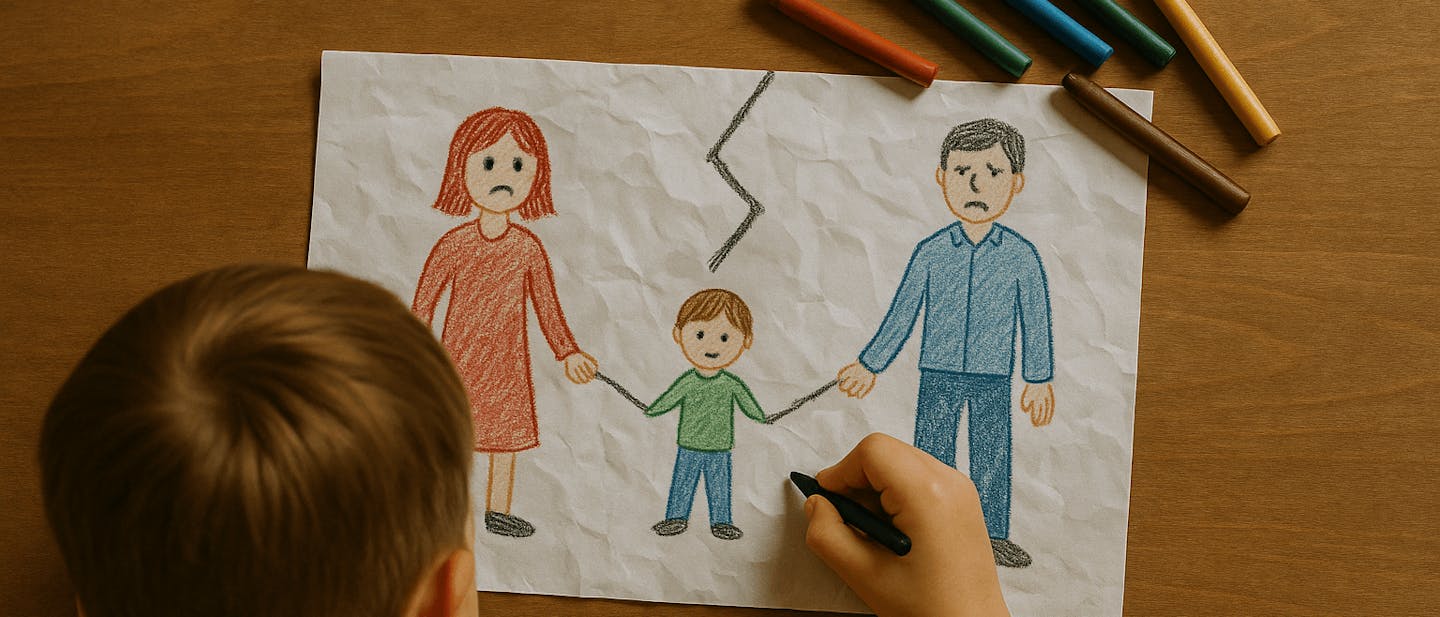
Divorces are common today, but that doesn’t mean they’re easy. Especially not for children, who find themselves caught between two worlds, two homes, and often two emotionally wounded parents. We spoke with Matej Zaplotnik, a counselor for children and parents with years of experience supporting parents through divorce, about how divorce affects children, why so many children feel guilty, and how parents can prevent the worst consequences.
Matej’s professional career began at a reform school and a center for children with emotional and behavioral difficulties. But he soon noticed an unusually recurring pattern:
a large proportion of the children who needed professional help came from families where the parents had divorced. The studies that paved his path to working with children and adolescents did not address in detail the challenges children face when their parents divorce. “I felt powerless when working with such families,” he says. It was precisely this feeling that prompted him to delve deeply into the field of divorce, study the literature, translate books, and begin specializing in helping both parents and children who share this experience.
Among his many practical experiences, one had a particularly profound impact on his future work: a conversation with a 14-year-old boy from a residential group who believed he was to blame for his parents’ divorce. His parents had separated when he was barely two years old, yet for twelve years the boy had carried the burden of believing that he had broken up the family. “His answer shook me. He said that as a baby he cried a lot at night and that his parents argued a lot because of it. Based on that, he created a story in his mind that he was to blame for the divorce.” This experience was a turning point in Matej’s journey: proof of how long-lasting and profound the consequences can be if parents don’t help their child properly understand divorce.
Why do children take the blame?
In Matej’s experience, this happens very often. Not because someone has explicitly told them they are to blame—but because of an inner need for control. “If a child thinks he is to blame, then he also believes he can fix things. This gives him a sense of control in a situation where he would otherwise feel completely powerless.”
How does divorce affect a child’s mental health?
The effects of divorce on a child vary widely, depending on the family dynamics and the level of conflict between the parents. Among the most common issues are: anxiety, depression, and feelings of loneliness; eating disorders (anorexia, bulimia)—these are more common in girls—behavioral problems, seeking belonging in high-risk groups—these are more common in boys—reduced concentration, excessive sensitivity, and rejection of one parent due to manipulation or emotional pressure.
Matej specifically highlights the feeling of rejection that a child experiences when parents become preoccupied with their own emotions, new partners, and relationship conflicts. “When a child senses that parents are prioritizing their own needs, they feel a strong sense of rejection, and this is the foundation for many subsequent problems.”
The most critical period: the beginning of the separation
In his experience, parents most often seek help too late, frequently only after years of legal battles. But the crucial period is precisely the early stages of the breakup, when the child senses tension, perceives the parents’ sadness or anger, and does not yet fully understand what is happening, yet needs clarity and security. Matej therefore emphasizes: “A five-year-old child is quite capable of understanding what is happening. They sense the tension very well. It is the parents’ job to explain to them in an age-appropriate way what will change.”
What can parents do to protect their child?
In our conversation, Matej highlights a few key steps parents should take to mitigate the difficult changes that a separation brings for the child:
1. Both parents must agree on the decision to separate
The child needs clarity. If one parent continues to hope for a reconciliation, communication with the child becomes confusing.
2. Explain to the child what will change
Together and in the same way. Avoid making promises that cannot be kept later.
3. Establish a clear, child-friendly parenting plan
The plan should outline: transitions between homes, daily routines, vacations, holidays, communication, and how to resolve any issues. The more conflict there is between the parents, the more detailed the plan needs to be.
4. Respect the other parent’s role
The child needs both parents, even if they don’t get along. The most harm to the child comes from speaking negatively about the other parent, as well as emotional blackmail and restricting contact.
5. Don’t involve the child in your disputes
The child is not a mediator, judge, or therapist.
The greatest danger lies in the manipulation of children
Matej points out that emotional manipulation of children is more common than parents admit. Children often express desires or feelings that are not their own, but rather a reflection of the influence of one of their parents. Matej describes this type of manipulation, in which a child is used to reject the other parent, as one of the most harmful and often overlooked forms of psychological abuse. This is a form of emotional manipulation in which parents consciously guide the child to reject one of the parents. This does not happen unconsciously, as is sometimes the case when parents say things that their own parents once said to them. Manipulating a child to reject the other parent is a conscious decision.
Can a teenager help make decisions?
When parents are divorcing, a child’s opinion can be valuable, but their involvement must be handled with care, says family therapist Matej. It always makes sense to talk to the child about their feelings, fears, and wishes, as this helps us understand how they see the situation; however, the child must not become the one bearing the responsibility for the decisions. Matej cautions: “Parents must listen to the child, but balance their words with the overall situation and always make decisions in the child’s best interest.”
A teenager might say they want to live with one parent out of convenience, leniency, or even under the influence of manipulation, which—as he says—often happens consciously. That’s why it’s important to take the child’s words seriously, but with a clear understanding of the broader context. The child should feel heard and understood, not placed in the role of the one who has to make the decision. As Matej says: “The parents must make the decision themselves—the child’s opinion should be one of the important factors, but not the deciding one.”
How does counseling with Matej work?
Counseling with Matej takes place in several steps—first, he and the parent review the family situation together: what is happening among family members, where things are getting stuck, and what challenges the children are facing. Matej helps parents recognize the child’s words that may not reflect their true feelings but are influenced by the other parent. At the first meeting, he discusses with the parent what the child needs most at the moment, how contact is going, and what options parents have to improve the child’s situation in the context of their separated relationship.
Matej prefers to work with parents at the beginning of the separation, as that is when matters can be resolved peacefully and in a child-friendly manner. Together, they go through six proven steps for a parenting plan, which provide clear guidelines for reaching an agreement on custody and child-rearing. For parents who come for counseling in the later stages of the separation, he helps them untangle complex dynamics, recognize manipulative patterns, and negotiate more effectively with the other parent.
The most successful parents are those who commit to change early on and gradually build a stable and fair agreement regarding the children.